
Ohio Cannabis Operators Left Without Answers as Federal Rescheduling Creates Dual-Schedule Confusion
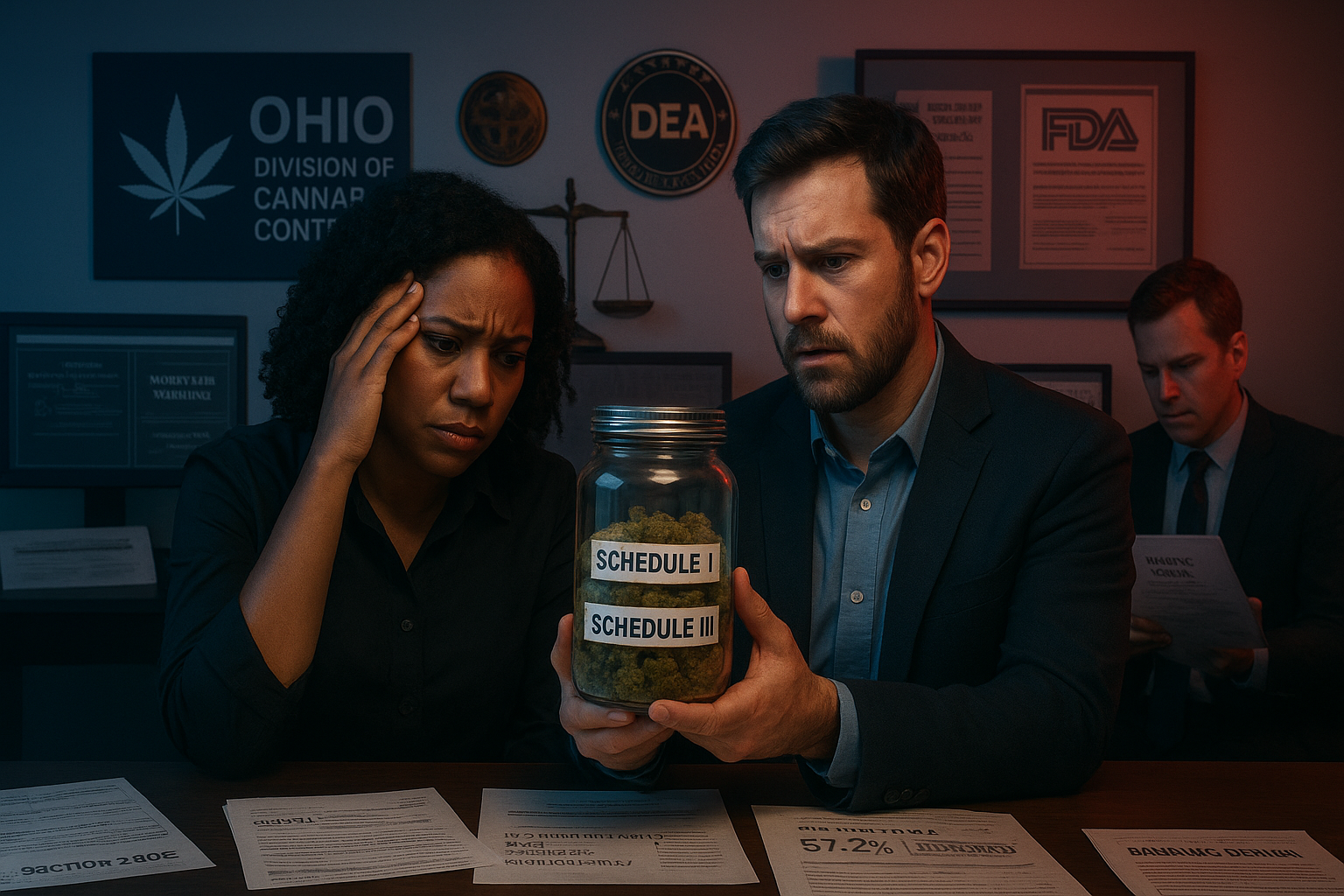
Ohio's licensed cannabis operators are stuck in a regulatory holding pattern - and their own state agency can't help them out of it. The Ohio Division of Cannabis Control has told operators it lacks the federal guidance needed to advise them on what Acting Attorney General Todd Blanche's April 22 rescheduling order means for their businesses, leaving companies that sell both medical and adult-use cannabis in a legally ambiguous position with real financial consequences. For a state where medical cannabis still accounts for more than 22% of total sales in 2025, the uncertainty isn't abstract.
The core problem is structural. Ohio operates what DCC Deputy Chief Legal Counsel Kathryn Cornelius described during an Ohio State University Drug Enforcement and Policy Center webinar on June 16 as a "truly dual-licensed" system - a single license that covers both medical and adult-use activity up until the point of sale. That architecture, which streamlined operations when Ohio transitioned its medical operators into the adult-use market after voters legalized recreational cannabis with a 57.2% majority in 2023, now creates a compliance headache that state regulators don't know how to unwind. Other state markets have wrestled with analogous operational complexities - vendors offering marijuana pos software alaska dispensaries use, for instance, have long had to account for the technical distinctions between medical and adult-use transactions at the point of sale, underscoring how deeply licensing architecture shapes retail technology choices and compliance workflows across the country.
What makes Ohio's situation particularly thorny is that Blanche's order bifurcates cannabis scheduling by use type, not by product. State-licensed medical cannabis is moved to Schedule III, while adult-use cannabis stays on Schedule I. The same jar of flower sitting on a licensed dispensary's shelf is simultaneously a Schedule I substance and a Schedule III substance - depending on who's buying it. Sam Kamin, the Chauncey G. Wilson Memorial Research Chair at the University of Denver Sturm College of Law, called this arrangement "very nonsensical, complicated and ultimately impossible" at the same OSU webinar. He's not wrong. Under Ohio's dual-license model, that distinction can't even be made at the licensing level - it can only be made at the register.
The 280E Question Ohio Operators Are Actually Asking
Behind the regulatory confusion sits a very concrete tax question. Section 280E of the Internal Revenue Code bars businesses trafficking in Schedule I or II controlled substances from taking ordinary business deductions - a provision that hits cannabis operators particularly hard, effectively taxing them on gross profit rather than net income. Rescheduling to Schedule III would theoretically free state-licensed medical cannabis businesses from that burden. But Ohio operators can't answer the question of whether they qualify, because their regulators can't answer it either.
Cornelius was direct about the limits of what DCC can say. The agency hasn't received clear guidance from the federal government, and without it, telling licensees how to proceed would amount to speculation with legal consequences. That's not a comfortable position for operators whose tax exposure can be existential. The DEA opened an expedited registration process for state-licensed medical cannabis businesses to apply for Schedule III recognition, with a window closing later this month. Ohio's dual-use operators are still trying to determine whether they're even eligible to apply - a question that remains unanswered.
Cornelius also raised an operational dimension that goes beyond taxes. If Ohio ultimately determines it needs to separate its dual licensing into distinct medical and adult-use licenses, the DCC would face an entirely new licensing event, rule amendments, and regulatory infrastructure - all while the underlying federal question remains unsettled. "Whether we would have to reissue or do another licensing event for medical licenses only is still to be determined," she said. That kind of structural unbundling would ripple through compliance systems, seed-to-sale tracking configurations, POS setups, and wholesale reporting frameworks across every licensed entity in the state.
The FD&C Act Problem Nobody's Talking About Enough
Even if the scheduling debate resolves cleanly - and there's no current reason to believe it will - Ohio operators and their counterparts across the country would still face a separate federal wall: the Food, Drug and Cosmetics Act. Robert Mikos, the LaRoche Family Chair in Law at Vanderbilt University Law School, made this point plainly at the webinar. Under the FD&C Act, Schedule III substances can only be lawfully distributed as FDA-approved prescriptions through DEA-registered entities like licensed pharmacies. State-licensed cannabis, regardless of scheduling, isn't FDA-approved. It's unprecedented to have a Schedule III substance that doesn't fit that framework.
That matters because the headaches operators have lived with - banking access, federal trademark registration, merchant processing, insurance coverage - don't go away just because cannabis moves down a schedule. Banks remain wary of accounts tied to businesses whose activities are technically unlawful under federal law, because those transactions carry money laundering implications. Federal trademark protection requires lawful commerce. None of that changes under Schedule III if the underlying commercial activity remains outside the FD&C Act's approval pathway. To put it plainly: rescheduling is not the same as federal legalization, and operators who've been waiting on 280E relief as a near-term certainty may be waiting longer than their accountants anticipated.
A Nationwide Ecosystem of Confusion
Ohio isn't an outlier here. Cat Packer, a distinguished cannabis policy practitioner at OSU's DEPC and director of drug markets and legal regulation at the Drug Policy Alliance, said she's spoken with cannabis regulators across the country in recent weeks - and their situation mirrors Ohio's. More questions than answers. No clear mechanism for translating what a federal DEA order means for individual state operators. No consensus on what applying for DEA registration actually obligates a business to do, or what happens to state-licensed operators who miss the expedited window or choose not to participate.
That last point carries real enforcement risk. Packer raised the question directly: if a state medical cannabis operator doesn't apply for DEA registration within the available window, are they supposed to stop operating? The DEA has since indicated it will continue accepting applications beyond the initial 60-day period - but that clarification came late, and the broader question of enforcement implications remains open. For multi-state operators running compliance and licensing across several markets simultaneously, the absence of federal clarity isn't an abstraction. It shows up in legal counsel costs, board-level risk discussions, and decisions about whether to expand, consolidate, or hold.
No substance has ever been listed simultaneously on two different CSA schedules. The administrative law judge hearing process that would determine whether adult-use cannabis stays on Schedule I is scheduled to begin June 29. Whether this split-schedule status lasts months or becomes a permanent regulatory feature depends on outcomes that are genuinely unknowable right now. What Ohio's operators - and their counterparts across every dual-market state - know is that they're being asked to make real business decisions with incomplete regulatory information, through no fault of their own state agencies.