
TerrAscend Acquires Aunt Mary's Dispensary in New Jersey, Betting on Vertical Integration Gains
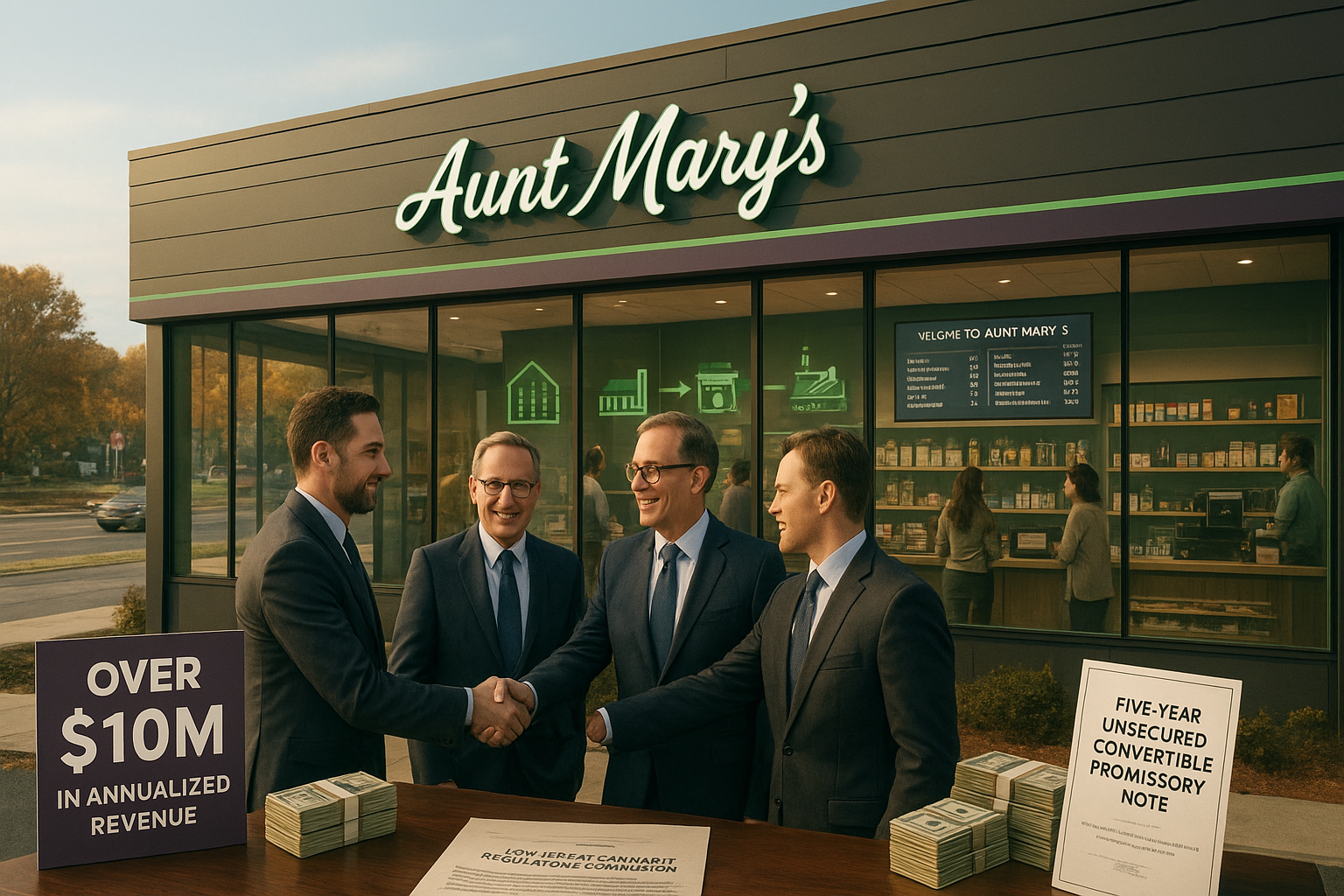
TerrAscend, the Canadian-headquartered multi-state operator, has agreed to acquire Aunt Mary's dispensary in Flemington, New Jersey - a 5,200-square-foot adult-use and medical cannabis retail operation in Hunterdon County that the company says generates over $10 million in annualized revenue. The deal, structured at $9 million total, combines $6 million in cash with $3 million in five-year unsecured convertible promissory notes bearing 6.0% interest, giving TerrAscend an option to purchase 35% of the business. The New Jersey Cannabis Regulatory Commission still has to sign off before it closes.
The acquisition follows a pattern MSOs have been running in regulated state markets for the past several years: identify a profitable independent with limited nearby competition, absorb it into a vertically integrated supply chain, and improve margins by swapping in house-branded product at lower wholesale cost. TerrAscend Executive Chairman Jason Wild framed it plainly - the company sees a "clear opportunity to enhance margins through vertical integration and the introduction of our premium brand portfolio." For operators running multi-state retail networks, that calculation is straightforward on paper: if you control cultivation, processing, manufacturing, and the retail counter, you're not paying someone else's markup at every step. It's the same logic that drives decisions in any consumer goods retail channel, cannabis or otherwise. Operators building out compliant retail infrastructure across state lines - whether they're relying on a Metrc-compliant POS for Colorado or integrating seed-to-sale tracking in New Jersey - know that tightening the supply chain is where margin recovery actually happens, not at the register.
Aunt Mary's is not a small operation by independent dispensary standards. The Flemington location sits in what TerrAscend describes as a high-traffic retail corridor, and the business holds a vertically integrated cannabis license - dispensary, cultivation, and manufacturing - originally awarded by the CRC to the entity then operating as Altus New Jersey during the 2019-2021 medical cannabis lottery round. It opened for medical sales in February 2023 and has since been approved for adult-use. That license structure matters. A vertically integrated license in New Jersey is a meaningful asset, not just a retail permit. Acquiring a business that already holds cultivation and manufacturing approvals shortcuts a regulatory process that can take years and produce no guarantee of approval.
The Diversity Ownership Question Isn't Answered Cleanly
TerrAscend's announcement states that "the transaction conforms to New Jersey's regulatory framework, which facilitates investment opportunities for diversely owned businesses" - but the company doesn't explain what makes Aunt Mary's a diversely owned business under the CRC's definitions. That's not a minor detail. New Jersey's regulatory framework includes specific provisions around social equity and diverse ownership, and characterizing a transaction as compliant with those provisions without spelling out the basis invites questions. The CRC will presumably scrutinize this as part of its approval review. Dispensary operators and investors watching the New Jersey M&A market should pay attention to how that language is ultimately substantiated.
TerrAscend's Broader Position Is More Complicated Than the Press Release Suggests
Here's the catch: TerrAscend is not acquiring Aunt Mary's from a position of uncomplicated strength. The company's stock trades on Canadian exchanges at under a dollar per share. The federal government filed a lawsuit against the company in 2024 seeking $8.3 million in unpaid taxes - a reminder that 280E, the Internal Revenue Code provision that disallows standard business deductions for cannabis companies operating in Schedule I, continues to create genuine financial stress across the MSO sector. Reports also indicate the company is dealing with labor disputes and litigation in other states.
TerrAscend has also expressed interest in listing on U.S. stock exchanges - a move that would depend heavily on the federal regulatory environment shifting in a meaningful way. The Trump administration has proposed rescheduling cannabis from Schedule I to Schedule III, which would, among other things, relieve operators of 280E's tax burden. But proposed rescheduling is not rescheduling. If that process stalls, the financial pressure on MSOs trading at sub-dollar valuations becomes harder to manage, and the math on acquisitions funded partly through convertible notes starts to look different.
What's striking here is the gap between the optimism built into acquisition announcements and the operational and financial headwinds sitting just behind them. A $10 million annualized revenue dispensary in central New Jersey is a real asset. TerrAscend's brand portfolio - which includes Kind Tree, State Flower, Cookies, and Wana, among others - gives it genuine shelf product to push through Aunt Mary's budroom once the deal closes. The vertical integration thesis is sound in principle. But sound in principle and sound in execution are two different things, especially for a company managing a federal tax dispute, labor friction, and a stock price that doesn't give it much room for error.
What This Means for the New Jersey Market
For independent dispensary operators in New Jersey, the Aunt Mary's transaction is another data point in a consolidation trend that was inevitable once the adult-use market opened and MSOs began evaluating their retail footprint state by state. A well-located, vertically licensed independent generating eight figures in annual revenue is exactly what a larger operator wants to absorb rather than compete against. The CRC's approval process is the remaining variable - the commission has been deliberate about reviewing transactions involving diverse ownership provisions, as it was with the Union Chill acquisition in Lambertville that TerrAscend also completed.
One operational note worth keeping in mind: when an MSO integrates an independent dispensary into its supply chain, the product mix at the retail counter typically shifts. House brands and licensed brand partners replace the broader wholesale menu the independent was carrying. For the local consumer base that developed purchasing habits at Aunt Mary's under its current product selection, that transition is noticeable. For TerrAscend's margin targets, it's the point of the exercise.
Whether there's a real Aunt Mary - the way Wendy's Wendy was real and Betty Crocker was not - the brand name stays on the door for now. That's a business decision about customer retention. The rest of the decisions from here will be about whether TerrAscend can execute the vertical integration play efficiently enough to make a $9 million acquisition look disciplined rather than opportunistic.