
How Dispensary Management Software Combines Cannabis POS, Inventory, Compliance, and Point of Sale Systems
Running a cannabis dispensary means operating under a set of pressures that most retail businesses never encounter: real-time regulatory reporting, strict inventory tracking tied to state licensing, age verification at every transaction, and product compliance documentation that must be audit-ready at any moment. A single software gap - say, a POS system that doesn't sync with your state traceability platform - can result in fines, license suspensions, or worse. This is precisely why purpose-built dispensary management software has become infrastructure rather than a convenience.
Most dispensary operators start by solving one problem at a time: a point of sale here, a spreadsheet for inventory there, a compliance checklist on paper. The result is a patchwork that creates more problems than it solves. The real operational shift happens when all these functions - sales, inventory, compliance, reporting - are managed through a single integrated platform. Understanding how that integration works, and why it matters, is what this article addresses directly.
Whether you're opening a new dispensary or replacing a system that has outgrown your needs, the decision you make about software will shape daily operations, staff efficiency, customer experience, and your relationship with regulators. This guide breaks down every layer of modern dispensary software, how the components interact, and what to prioritize when evaluating your options.
What Dispensary Management Software Actually Does
Beyond Basic Retail: The Dispensary-Specific Challenge
Standard retail software manages products, prices, and transactions. Dispensary management software does all of that while simultaneously tracking each product's origin, potency, batch number, and compliance status - and reporting many of those data points to a government traceability system in real time. The operational complexity is genuinely different in kind, not just in degree.
Cannabis retail is regulated at the state level, and those regulations vary significantly. In some states, every gram sold must be reported to a track-and-trace system like Metrc or BioTrackTHC within minutes of the transaction. In others, daily reconciliation reports are required. A dispensary operating in multiple states may be subject to multiple reporting frameworks simultaneously. Software that isn't built specifically for cannabis cannot handle this natively.
This is why dispensary-specific platforms exist as a category. They're not adapted from grocery or pharmacy software. They're engineered from the ground up to treat compliance as a core function, not an add-on.
The Core Components of an Integrated Platform
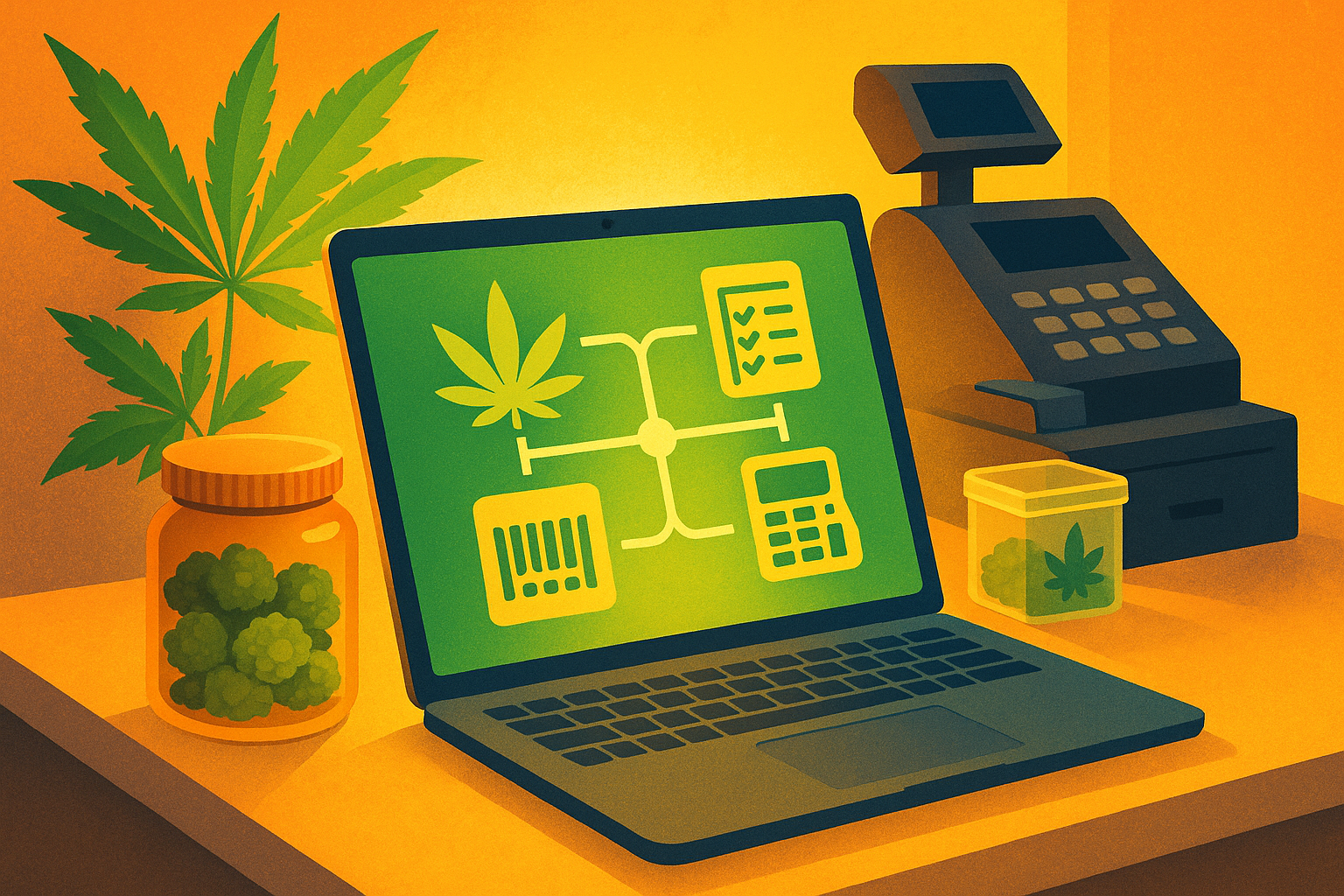
A fully integrated dispensary management software platform typically combines four functional layers:
- Point of sale: Transaction processing, payment handling, customer verification, and receipt generation
- Inventory management: Product intake, real-time stock tracking, batch management, and shrinkage monitoring
- Compliance reporting: Automated data transmission to state traceability systems, audit logging, and license documentation
- Customer relationship management: Loyalty programs, purchase history, and communication tools
When these components are built into a single system rather than stitched together from different vendors, data flows without friction. A sale logged at the register automatically reduces inventory and triggers a compliance report - no manual steps, no reconciliation errors at end of shift.
Why Integration Matters More Than Individual Feature Quality
A dispensary that uses best-in-class tools for each function separately - a great POS, strong inventory software, a dedicated compliance tool - can still face serious operational problems if those tools don't communicate reliably. Data silos create lag. Lag creates discrepancies. Discrepancies create compliance exposure.
Integration isn't just about convenience. When your cannabis dispensary POS software and your inventory system share a single database, there's no version of your stock count that's "more current" than another. There's one number, updated with each transaction. That accuracy is what regulators expect and what auditors examine first.
How Cannabis Dispensary POS Software Works at the Core
Transaction Processing in a Regulated Environment
The dispensary point of sale system is where the customer experience and regulatory obligation meet. Every transaction must verify the customer's age and, in medical markets, their patient status. It must apply purchase limits correctly - daily limits vary by state and product type. It must calculate applicable taxes, which in cannabis retail can include state excise tax, local cannabis taxes, and standard sales tax layered on top of each other.
A well-designed cannabis dispensary POS software handles all of this at the moment of sale without slowing down the transaction. Age verification integrates with ID scanning tools. Purchase limits are enforced automatically based on what the customer has already bought that day, pulled from the compliance database. Tax calculations are built into the product catalog, not manually applied at checkout.
For medical dispensaries specifically, the software must also manage patient purchase limits separately from adult-use limits, often with different tax treatment as well. The right medical dispensary software, such as the solutions described at medical dispensary point of sale platforms, handles these distinctions natively without requiring staff to memorize rule sets for every transaction.
Payment Processing Complexity in Cannabis Retail
Cannabis remains federally classified as a Schedule I controlled substance in the United States, which means most national banks and card networks decline to process cannabis payments directly. This creates a payment landscape unlike almost any other retail category. Dispensaries commonly manage a mix of cash, cashless ATM transactions, debit-based PIN systems, and in some markets, emerging cannabis-specific payment processors.
A capable dispensary point of sale system accommodates this complexity. It tracks cash transactions accurately, handles multiple payment types within a single transaction, and maintains an audit trail that satisfies both internal accounting requirements and regulatory scrutiny. Drawer reconciliation at the end of a shift should be automated, comparing expected cash against recorded transactions without manual counting errors becoming a compliance issue.
Customer Experience at the Register
Speed matters in dispensary retail. Long lines reduce revenue and customer satisfaction equally. Modern cannabis dispensary POS software supports features like menu integration - so budtenders can see current stock and product details on the same screen they use to ring up sales - express checkout for returning customers, and mobile POS options for high-traffic periods.
The POS is also where loyalty programs activate. When purchase history is tracked at the transaction level, dispensaries can offer points, tier-based discounts, and personalized recommendations without requiring a separate system. This data also informs purchasing decisions: which products sell fastest, which strains underperform, what time of day drives the most volume.
Marijuana Dispensary Inventory Software: Precision That Compliance Demands
From Intake to Sale: Full Chain of Custody
Inventory management in cannabis is not optional detail work. State regulations typically require that every product that enters a dispensary can be traced back to the cultivator or manufacturer, through processing, through transportation, and into the retail environment. Marijuana dispensary inventory software is the system that maintains this chain of custody at the product level.
When a delivery arrives, the intake process should create a digital record that matches the manifest from the supplier. Batch numbers, product weights, THC percentages, expiration dates - all of this enters the system at intake and follows the product through its entire retail life. When it sells, the record closes. When it's returned or destroyed, that event is documented with a reason code and a timestamp.
Any gap in this chain is a regulatory exposure. Regulators conducting an audit can pull a product's full history. If a dispensary cannot produce that history because records weren't maintained consistently, the liability is significant regardless of whether actual diversion occurred.
Real-Time Stock Visibility and Shrinkage Control
Accurate real-time inventory means knowing exactly how much of every product is on hand at any moment - not what was on hand at last night's close, and not a figure that will be accurate after someone manually enters a transfer. Marijuana dispensary inventory software achieves this by updating stock counts automatically with each transaction, each transfer, and each adjustment.
Shrinkage in cannabis retail - product loss that doesn't correspond to a recorded sale or authorized disposal - is a serious problem. Unlike a grocery store where shrinkage might mean a few stolen items, cannabis shrinkage triggers regulatory scrutiny. An integrated system flags discrepancies between expected and actual inventory in real time, allowing managers to investigate before a small inconsistency becomes a pattern that attracts regulator attention.
Reorder Management and Purchasing Efficiency
Beyond compliance, marijuana dispensary inventory software serves a straightforward operational function: keeping shelves stocked without over-ordering. Reorder thresholds can be set at the product or category level, triggering alerts when stock falls below a defined quantity. Purchase order management built into the same system allows buyers to request product from licensed suppliers, track delivery timelines, and reconcile received inventory against orders - all without leaving the platform.
This visibility also informs vendor relationships. A dispensary with reliable inventory data can negotiate more effectively with cultivators and distributors, because it knows exactly how fast specific products move and what margin each category delivers.
Dispensary Compliance Software: Regulatory Reporting Without Manual Risk
State Traceability Systems and API Integration
Nearly every legal cannabis market in the United States requires dispensaries to report sales and inventory data to a state-managed traceability platform. Metrc is the most widely deployed, used in the majority of adult-use states. BioTrackTHC operates in several others. Each platform has its own API, data format requirements, and reporting timelines.
Dispensary compliance software that integrates directly with these platforms removes the most dangerous step in the compliance workflow: manual data entry. When a transaction is recorded in the POS, the compliance module formats that data according to the state's requirements and transmits it through the API automatically. The reporter never touches a spreadsheet. Errors introduced by transcription don't exist.
For multi-state operators, this matters even more. A platform with pre-built integrations for multiple traceability systems means the same software infrastructure supports compliance across different regulatory environments without requiring separate compliance tools in each market.
Audit Logging and Documentation Management
Regulators don't just want current data. They want to be able to review what happened historically - who made which changes, when, and why. Dispensary compliance software maintains detailed audit logs that record every action taken in the system: inventory adjustments, voided transactions, user logins, price changes, and configuration modifications.
This audit trail serves two purposes. It deters internal misconduct, because staff know every action is logged. And it provides the documentation foundation for a regulatory inspection. When an inspector asks for records of a specific product or time period, the software produces them in seconds rather than requiring someone to search through paper files or disconnected spreadsheets.
License Management and Compliance Calendars
Beyond transaction-level reporting, cannabis dispensaries manage a portfolio of licenses, permits, and certifications that have different renewal dates, continuing education requirements, and documentation obligations. Dispensary compliance software with license management features tracks these deadlines and surfaces alerts before they become missed deadlines.
A dispensary operating without this visibility risks allowing a license to lapse - an event that can force a temporary closure while reinstatement is processed. That's a business continuity risk as much as a compliance risk. Centralizing these obligations in the same platform used for daily operations means compliance isn't a separate administrative function but a visible, integrated part of how the business runs.
The Dispensary Point of Sale System as the Operational Hub
How the POS Connects Every Function
In a well-designed integrated platform, the dispensary point of sale system is not just a cash register. It's the interface through which every other function is triggered. A completed sale updates inventory, generates a compliance report, adds to the customer's purchase history, applies loyalty points, and records the transaction in accounting - simultaneously, without any additional input from staff.
This is the operational argument for integration that goes beyond compliance. The hours spent on daily reconciliation, manual inventory counts, and copying data between systems represent real labor costs. When the POS is the hub that feeds all other systems, those hours are redirected toward customer service, staff training, or business development rather than administrative correction work.
Hardware Considerations for Dispensary POS Deployments
The physical setup of a dispensary point of sale system affects both speed and security. Most dispensaries operate with dedicated POS terminals at the register, supplemented by tablet or mobile devices for floor sales staff. The hardware must meet the software requirements - processing speed, screen size, peripheral compatibility for ID scanners, receipt printers, and cash drawers - while also fitting the physical layout of the retail space.
Security matters at the hardware level as well. Terminals should be positioned so customer financial information isn't visible to other shoppers. Card reader placement should follow payment security standards even in a cashless-ATM environment. These considerations are typically addressed during the onboarding process with the software vendor, but operators should understand them before signing hardware agreements.
Multi-Location and Franchise Operations
For dispensary groups operating multiple locations, the point of sale system must support centralized management while allowing location-level reporting. Product catalogs, pricing, and promotions may need to vary by location or be enforced uniformly - the platform should support both scenarios. A regional manager reviewing performance across five locations needs consolidated data that doesn't require manually combining reports from five separate systems.
Multi-location operators also benefit from centralized purchasing: if one location runs low on a top-selling product, inventory can be transferred from another location, with that transfer recorded in both systems and reported to the state traceability platform automatically. This kind of operational flexibility requires software that treats the enterprise as a single entity with multiple nodes, not as independent installations that happen to share a vendor.
Evaluating and Implementing Dispensary Management Software
What to Assess Before Selecting a Platform
The selection process for dispensary management software deserves the same rigor as selecting a physical location. The wrong platform creates operational drag that compounds over time. The right one becomes a competitive asset.
Key factors to evaluate include:
- State compliance coverage: Does the platform have active, maintained integrations with your state's traceability system, and how quickly does it update when regulations change?
- POS reliability: What happens when internet connectivity fails? Does the system operate in offline mode and sync when connectivity restores?
- Inventory accuracy: How does the system handle partial units, returns, and multi-unit packages? Cannabis products vary widely in how they're counted and sold.
- Reporting depth: Can you pull the reports you need for business decisions, not just the ones required for compliance?
- Support quality: When something breaks at 6pm on a Friday, who answers?
References from other dispensary operators using the platform in your state are more valuable than any sales demonstration. The demonstration shows what the software can do. References reveal how it actually performs under real operating conditions.
Implementation: What the Transition Actually Involves
Switching dispensary management software mid-operation is disruptive. The data migration process - moving product catalogs, customer records, historical transactions, and compliance logs from an old system to a new one - requires careful planning and verification. Running parallel systems during a transition period adds workload but provides a safety net if errors appear.
Staff training is the variable most operators underestimate. The software can be technically excellent, but if budtenders and managers don't know how to use it correctly, compliance errors will occur. Training should be role-specific: cashiers need depth on the POS workflow, inventory managers need thorough grounding in the intake and adjustment processes, and compliance officers need to understand how the reporting integrations function and where to verify that transmissions are succeeding.
Ongoing Optimization After Go-Live
The go-live date is not the end of the implementation process. Most dispensaries take several months to fully optimize a new platform - adjusting product catalog structure, refining reorder thresholds, customizing reports, and identifying workflows that can be automated further. The software vendor's customer success team should be a resource throughout this period, not just during initial setup.
Platform updates are an ongoing consideration as well. Cannabis regulations change, and the dispensary compliance software component of your platform must be updated in response. A vendor who maintains current integrations with state systems and communicates proactively about regulatory changes is not a luxury - it's a fundamental requirement for a tool that carries compliance obligations.
Frequently Asked Questions
Can a dispensary use separate software tools for POS, inventory, and compliance instead of one integrated platform?
Technically yes, but the operational and compliance risks multiply significantly. When systems don't share a live database, data discrepancies accumulate between platforms, requiring manual reconciliation that introduces errors. State regulators examining your records don't distinguish between software problems and intentional discrepancies - inaccurate records are a violation regardless of cause.
How does dispensary compliance software handle states that change their reporting requirements mid-year?
Reputable platforms push regulatory updates as part of their software maintenance cycle, similar to how any software pushes patches. The critical question to ask any vendor is how quickly they've historically deployed updates when a state modifies its traceability API or reporting format, and whether they communicate those changes proactively to clients before the effective date.
What happens to POS and inventory data if the internet goes down during operating hours?
Better cannabis dispensary POS software includes an offline mode that continues processing transactions locally and syncs with the central database and state compliance system when connectivity restores. Not all platforms offer this, and the ones that don't leave dispensaries in the difficult position of either turning away customers during an outage or processing sales manually and hoping reconciliation goes smoothly.
How does marijuana dispensary inventory software handle products with variable weights, like flower sold by the gram?
Platforms designed for cannabis account for unit-based and weight-based inventory simultaneously. Flower is typically tracked by weight at intake and converted to transaction units at the point of sale - so a half-ounce jar sold by the gram deducts the correct weight from inventory with each sale. This requires the product catalog to be configured correctly at intake, with accurate weights per unit tied to the original batch record.
Is cloud-based dispensary management software safer than locally hosted systems from a compliance standpoint?
Cloud-based platforms generally offer stronger disaster recovery, automatic backups, and easier remote access for multi-location monitoring. Local compliance data is maintained on the vendor's servers rather than a single on-site machine that can fail or be physically compromised. However, cloud dependency means internet reliability becomes critical infrastructure - which is why offline POS capability matters regardless of hosting model.
How should a dispensary evaluate whether its current software is causing compliance exposure?
Run a manual spot-check: compare your physical inventory count for a handful of SKUs against what your software reports, then verify that the software's reported transactions for those items match what was transmitted to your state traceability platform. Discrepancies at either step indicate a data integrity problem that warrants a full audit of your current platform's performance and, depending on the scope, disclosure to your compliance attorney before your next regulatory inspection.