
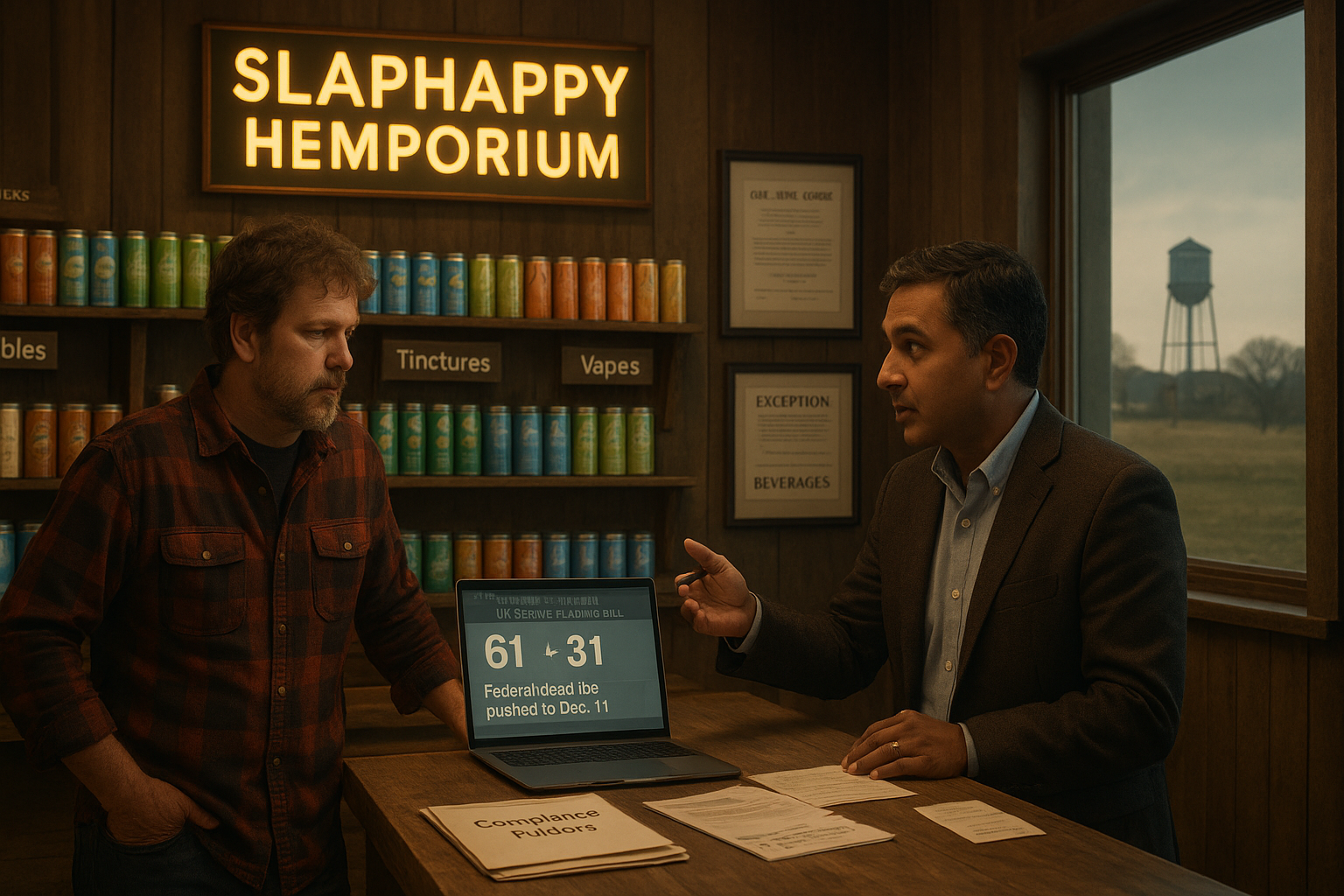
A short-term federal funding measure could give Missouri retailers a few more weeks of legal runway to sell hemp-derived THC beverages, even as the state's broader ban on intoxicating hemp products is still set to take effect Nov. 12. The U.S. Senate approved the funding bill in an overnight vote Saturday, Aug. 8, by a 61-31 margin, pushing the federal deadline for agency funding - and, tucked inside it, a delay of the federal intoxicating hemp ban - to Dec. 11. The bill now heads to the House, then to the president's desk, before anyone in Missouri's hemp trade can treat this as settled.
Here's the mechanism that matters for operators: Missouri's law, signed by Gov. Mike Kehoe this spring, was written to largely mirror the federal ban Congress passed last year. But state lawmakers built in a narrow exception. If Congress delays the federal ban, intoxicating hemp beverages get a pass in Missouri; everything else in the intoxicating hemp category - edibles, tinctures, vape products - still goes off shelves as scheduled. That's a meaningful distinction for inventory planning. A retailer running compliant packaging protocols and batch tracking across multiple product lines now has to sort SKUs by category, not just by potency or COA status, to figure out what survives past Nov. 12. For multi-state operators managing point-of-sale systems across different regulatory regimes - the kind of infrastructure decisions that also show up when evaluating something like cannabis POS for Texas dispensaries - this is a reminder that state-by-state carve-outs can scramble even well-built compliance logs overnight.
Jay Patel, president of the Missouri Hemp Trade Association, called the Senate vote a "good sign," but he's not treating it as a solution. "There's a lot of support from the White House actually to get some sort of regulation passed that's meaningful," Patel said. "Whatever happens on the federal side, it's not going to fully solve our problems in Missouri." That's a fair read. Even if Congress finalizes the delay, Missouri's own law still bans most intoxicating hemp categories in November - federal timing only rescues the beverage segment, and only because of how the state exception was drafted.
Litigation Adds Another Layer of Uncertainty
The Missouri Hemp Trade Association and a coalition of hemp businesses filed a federal lawsuit last month in the U.S. District Court for the Western District, arguing the state law's definitions of hemp and marijuana are unconstitutionally vague. That case is running on a separate track from the funding bill. Operators should treat it as a distinct variable - a favorable ruling could reshape compliance obligations regardless of what happens in Washington, while an unfavorable one leaves the Nov. 12 deadline intact for non-beverage products no matter what Congress does with funding timelines.
What This Means for Retail Operators on the Ground
John Grady, who owns Slaphappy Hemporium with his wife Kara in Rosebud, Missouri, put it plainly: the Senate action means "a strong likelihood" they'll keep selling THC seltzers through December. But he was equally clear about the limits. "We started off as a beverage producer," Grady said, "So for us, that is a good thing, but it also hurts the whole other part of our business." Customers are already stocking up on edibles and other items that face removal regardless of the federal timeline - a pattern familiar to anyone who's watched category bans roll out in other states, where consumer stockpiling ahead of a hard deadline creates a short-term sales spike followed by a cliff.
For store operators, the practical takeaway is inventory triage: separate beverage SKUs from the rest of the hemp product mix now, adjust wholesale ordering accordingly, and don't assume a federal delay resolves Missouri's compliance picture. The Gradys are among several hemp business owners pushing for comprehensive federal regulation before Dec. 11 - a deadline that, notably, is also just another point on the calendar rather than a guarantee of resolution.