
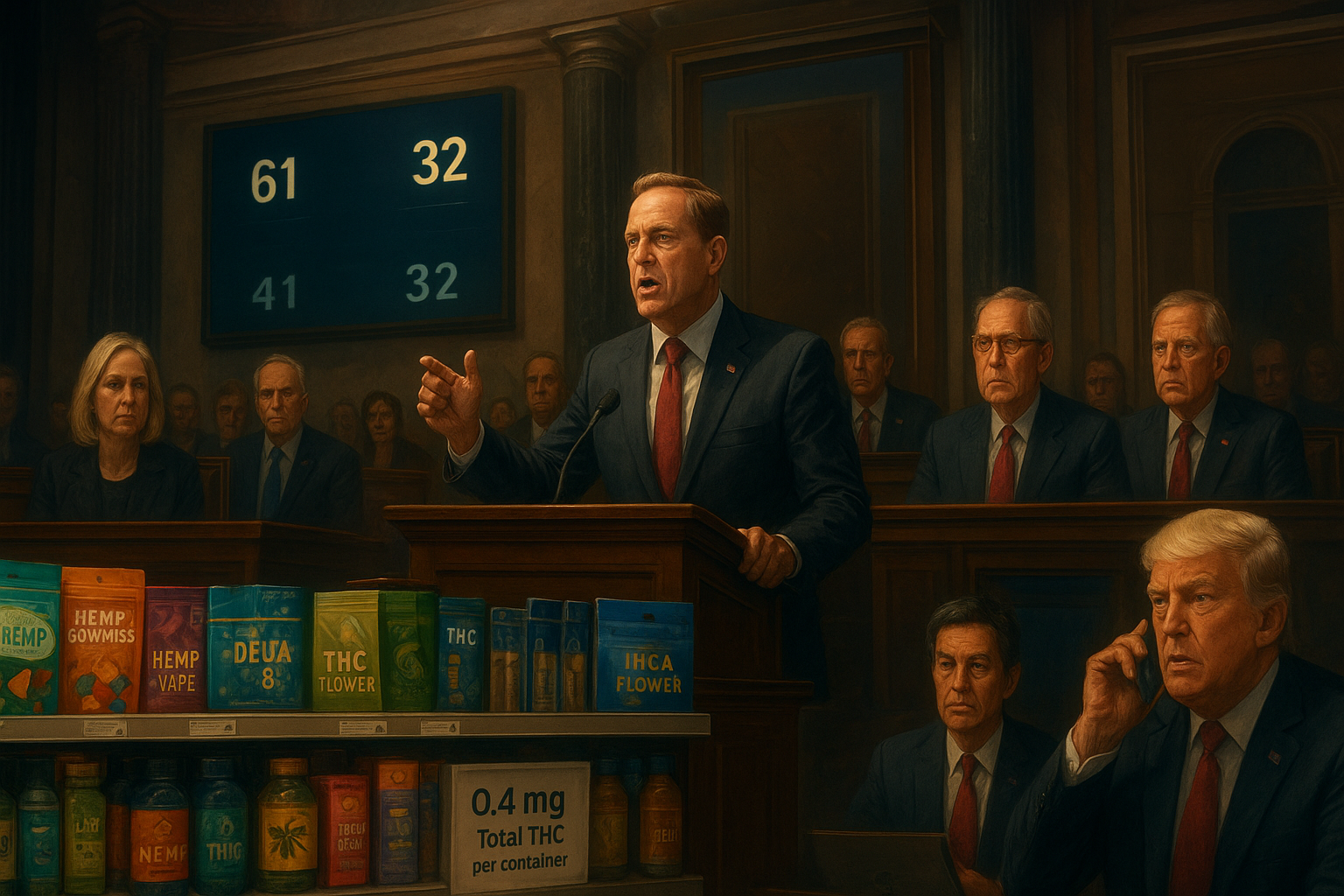
The US Senate voted 61-32 on Aug. 8 to table an amendment from Sen. Ted Budd, R-NC, that would have stripped a 30-day delay of federal hemp restrictions out of the chamber's continuing resolution. The vote keeps a temporary reprieve in place, pushing the effective date of sweeping new intoxicating hemp rules from Nov. 12 to Dec. 11, rather than letting the original deadline stand as Budd wanted.
For hemp retailers, brands, and the point-of-sale vendors that serve them, this is not an academic fight over a calendar date. It's a live compliance deadline that determines whether entire product categories - THC beverages, gummies, vapes, delta-8, THCA flower - stay on shelves or get pulled with little notice. Operators running multi-state footprints already know how disruptive a hard compliance cutover can be; the same operational logic that governs adult-use cannabis inventory resets applies here, right down to how retailers reconcile SKUs and update wholesale menus once a product category disappears overnight. States with established regulated cannabis retail infrastructure, where systems like South Dakota cannabis POS platforms already track compliant packaging and age verification at checkout, offer a rough preview of what a federally standardized hemp compliance regime might eventually demand of convenience stores and smoke shops never built for that level of oversight.
The Underlying Law and Why the Delay Matters
Congress passed the hemp definition change in November 2025, and it hinges on total THC rather than the older delta-9-only threshold that hemp companies had used to sell intoxicating products under the 2018 Farm Bill's loophole. The new standard caps combined total THC and similar cannabinoids at 0.4 milligrams per container in finished products. That's a dramatic tightening. It effectively reclassifies most of what's currently sold as "hemp-derived THC" - drinks, edibles, vapes - as noncompliant the moment the law takes effect. Budd argued that nine months was already generous, and that further delay simply protects a market he says still targets minors through candy-like packaging. Opponents, including a coalition of 105 organizations ranging from the US Hemp Roundtable to the National Association of Convenience Stores, argued the extra month gives Congress room to pass real regulation - age limits, lab testing, good manufacturing practices, restrictions on synthetic cannabinoid imports - instead of a blunt-instrument ban.
A Fractured Republican Coalition and a White House Warning
What's striking here is how the fight scrambled normal party lines. Budd picked up cosponsors from both sides - Gillibrand and Cornyn, Tillis and McConnell - while 21 Republicans joined 11 Democrats in opposing the motion to table. That's not a typical partisan split; it's a fight between states with entrenched hemp industries and those without one, and between lawmakers who want strict THC thresholds versus those who want a licensing and testing framework instead. The White House weighed in directly, with President Trump reportedly calling Budd, and CMS Administrator Dr. Mehmet Oz publicly warning that letting the broader restrictions take effect on schedule could disrupt CBD access programs for seniors and people with disabilities. Whether that argument holds up is a separate question from whether it worked - but it clearly shaped the Senate's calculus.
North Carolina's Parallel Deadlock Raises the Stakes
Back home, Budd's own state illustrates why this fight won't end in Washington. North Carolina's House Bill 328 would write the same 0.4-milligram total THC threshold directly into state law, meaning the prohibition survives regardless of what Congress ultimately does federally. The Senate passed the conference report 37-6 in July, but the House has stalled, sending it back to Rules Committee without a vote. Speaker Destin Hall says lawmakers agree the current unregulated market can't continue but disagree sharply on the fix. For dispensary operators, brand owners, and compliance teams watching this play out, the lesson is straightforward: a federal delay buys time, but it doesn't erase the underlying regulatory direction. States are moving toward hard THC thresholds with or without Congress, and retailers selling hemp-derived intoxicants need inventory and labeling strategies that can pivot fast - because the next deadline, wherever it lands, is not going away.