
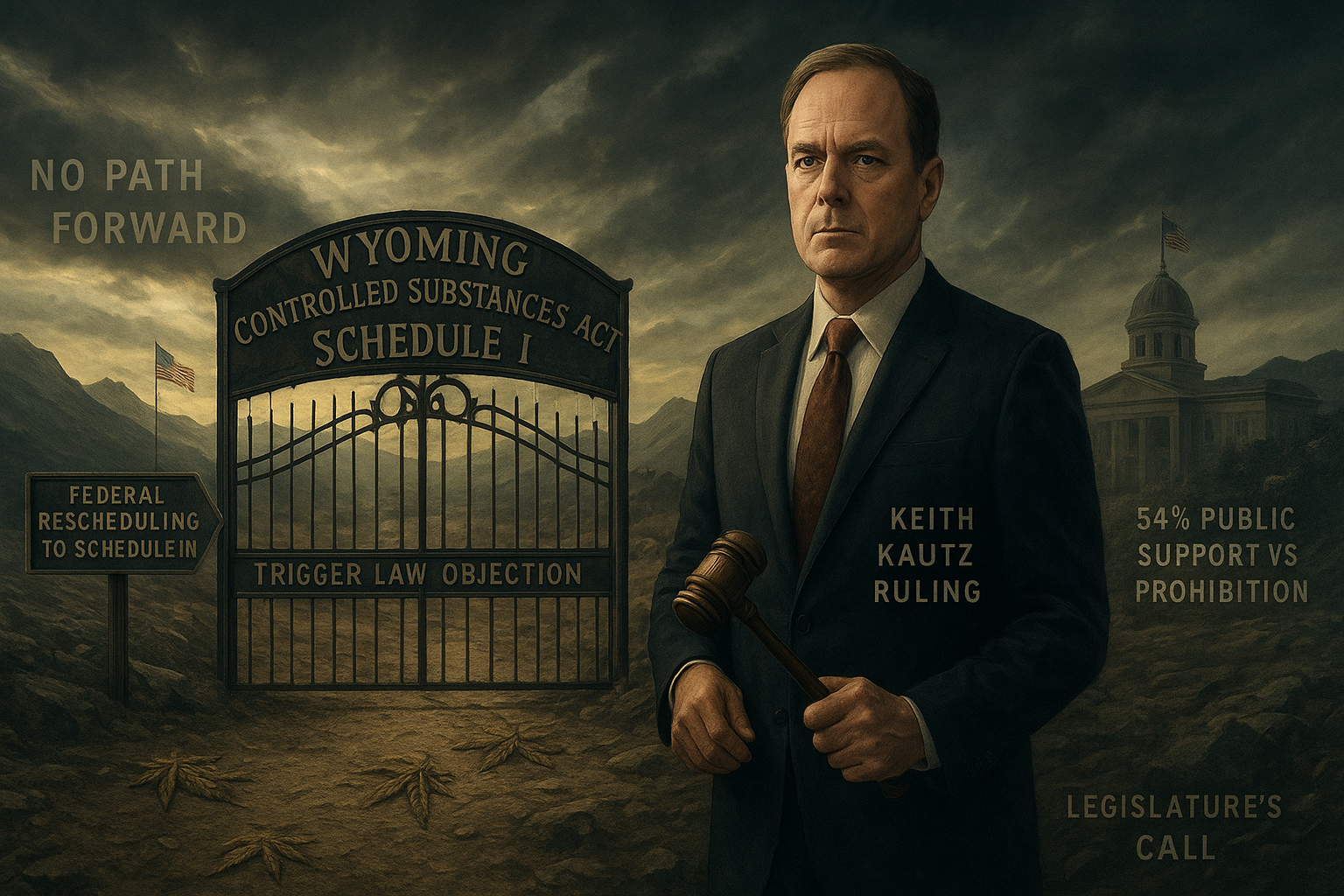
Wyoming's attorney general has formally rejected any automatic reclassification of marijuana under state law, ruling that cannabis will remain on Schedule I of the Wyoming Controlled Substances Act regardless of a federal rescheduling action by the Trump administration. Attorney General Keith Kautz, serving in his statutory role as commissioner of drugs and substances control, made the decision final after a public hearing in June and a comment period that drew only eight written responses. The ruling closes what had briefly appeared to be a regulatory opening - and puts Wyoming firmly in the column of states actively resisting the downstream effects of federal cannabis policy shifts.
The decision carries implications well beyond Wyoming's borders. States with licensed markets - and the compliance ecosystems that serve them - are watching closely as the patchwork of state responses to federal rescheduling grows more complicated by the week. For operators in states where frameworks already exist, the contrast is stark: dispensaries in markets like Michigan have had to build their entire compliance infrastructure around state-specific rules, investing in tools like compliant cannabis POS in Michigan precisely because federal ambiguity offers no reliable foundation. Wyoming illustrates what that ambiguity looks like at its most extreme - a state where no licensed retail infrastructure exists at all, and where even a modest administrative reclassification couldn't survive a single attorney general objection.
The Trigger Law That Didn't Fire
Here's the catch: Wyoming actually has a trigger law on the books. The legislature previously enacted a statute requiring the state's drug commissioner to mirror federal scheduling changes within 30 days of any federal reclassification. On paper, that sounds like an automatic mechanism. In practice, though, the same law grants the commissioner - Kautz - the right to formally object and convene a public hearing before any change takes effect. He exercised that right, convened the hearing, and then ruled against rescheduling.
His rationale is worth parsing carefully. Kautz's position rests on the argument that Wyoming has never legalized medical marijuana, has never established a state-licensed medical cannabis regulatory framework, and has never recognized licenses issued by other states. Therefore, placing marijuana in Schedule III - even only the category the federal order initially moved, which covers state-licensed medical products and FDA-approved formulations - would be "inconsistent with the police powers exercised to date by the Wyoming Legislature." To put it plainly: you can't schedule around a regulatory system that doesn't exist.
He also drew a clean line between the administrative rulemaking process and legislative action, stating that any decision to remove marijuana from Schedule I is the legislature's call to make - not a commissioner's administrative function. That framing matters, because it effectively forecloses any workaround through regulatory channels until lawmakers move first.
Where the Federal Order Actually Landed
The federal action underlying all of this came in April, when U.S. Acting Attorney General Todd Blanche issued an order moving state-licensed medical cannabis products - and any FDA-approved marijuana-derived formulations - from Schedule I to Schedule III of the federal Controlled Substances Act. A broader administrative hearing is currently ongoing that could extend Schedule III status to recreational products as well.
Kautz acknowledged the FDA-approved side of the equation, noting that drugs like dronabinol, Cesamet, and Epidiolex - all marijuana-derived or synthetic cannabinoid pharmaceuticals - are already scheduled in line with federal law at the state level. His office will continue to track FDA approvals and adjust state scheduling for individual approved substances accordingly. What he's blocking is the broader cannabis reclassification that would apply to products sold through a licensed dispensary system - a system Wyoming simply doesn't have.
A Pattern Taking Shape Across Holdout States
Wyoming isn't alone in this posture, and that's what makes the moment worth watching for anyone in regulated cannabis markets. Several states without comprehensive medical programs are arriving at similar conclusions through different procedural routes. Alabama's Department of Public Health voted to object to federal rescheduling while officials said they needed more time to assess implementation. Tennessee's governor signed legislation to block an automatic review that could have triggered medical cannabis access under state law. In South Carolina, a GOP senator declared that "medical marijuana is now legal" under a trigger law - the exact opposite interpretation of the same type of statutory mechanism Wyoming used to block rescheduling.
What this tells the broader industry is that federal rescheduling, even if eventually finalized at the administrative level, will not produce uniform state-level outcomes. Cannabis remains a state-by-state compliance reality, and operators building licensing strategies, wholesale distribution networks, or retail technology integrations cannot assume federal movement translates into state market access. The trigger law model was supposed to create alignment between state and federal scheduling - Wyoming's experience shows how easily that alignment can be severed by a single administrative objection.
What This Means for the Industry's Political Calculus
For advocates, the Wyoming ruling is a concrete reminder of how durable prohibition can be even when public opinion is shifting. A 2020 poll found that 54 percent of Wyoming residents supported adult-use legalization. That's a majority. And yet the legislature has repeatedly failed to advance reform - a decriminalization bill with bipartisan support didn't receive a vote, and an adult-use bill that cleared a House committee in 2021 went nowhere. The attorney general's decision is final unless altered by statute, as Kautz's announcement explicitly states. That means the legislature holds all the remaining cards, and based on its track record, it isn't in a hurry to play them.
For the broader cannabis business community, Wyoming is less a market opportunity than a case study in structural prohibition. There are no licensed operators, no compliant supply chains, no seed-to-sale tracking requirements, no excise tax frameworks, no dispensary real estate considerations, and no retail compliance obligations - because there is no legal market. What exists instead is a political standoff between a changing federal posture and a state government that has consistently chosen to treat cannabis reform as a legislative question it isn't ready to answer.
States with mature licensed markets will keep building infrastructure regardless of what Wyoming decides. But the fragmented state response to federal rescheduling is a signal that the compliance environment across the country is getting more complicated, not less - and that any operator, investor, or technology vendor with multi-state ambitions needs to account for that variability in every growth plan they write.