
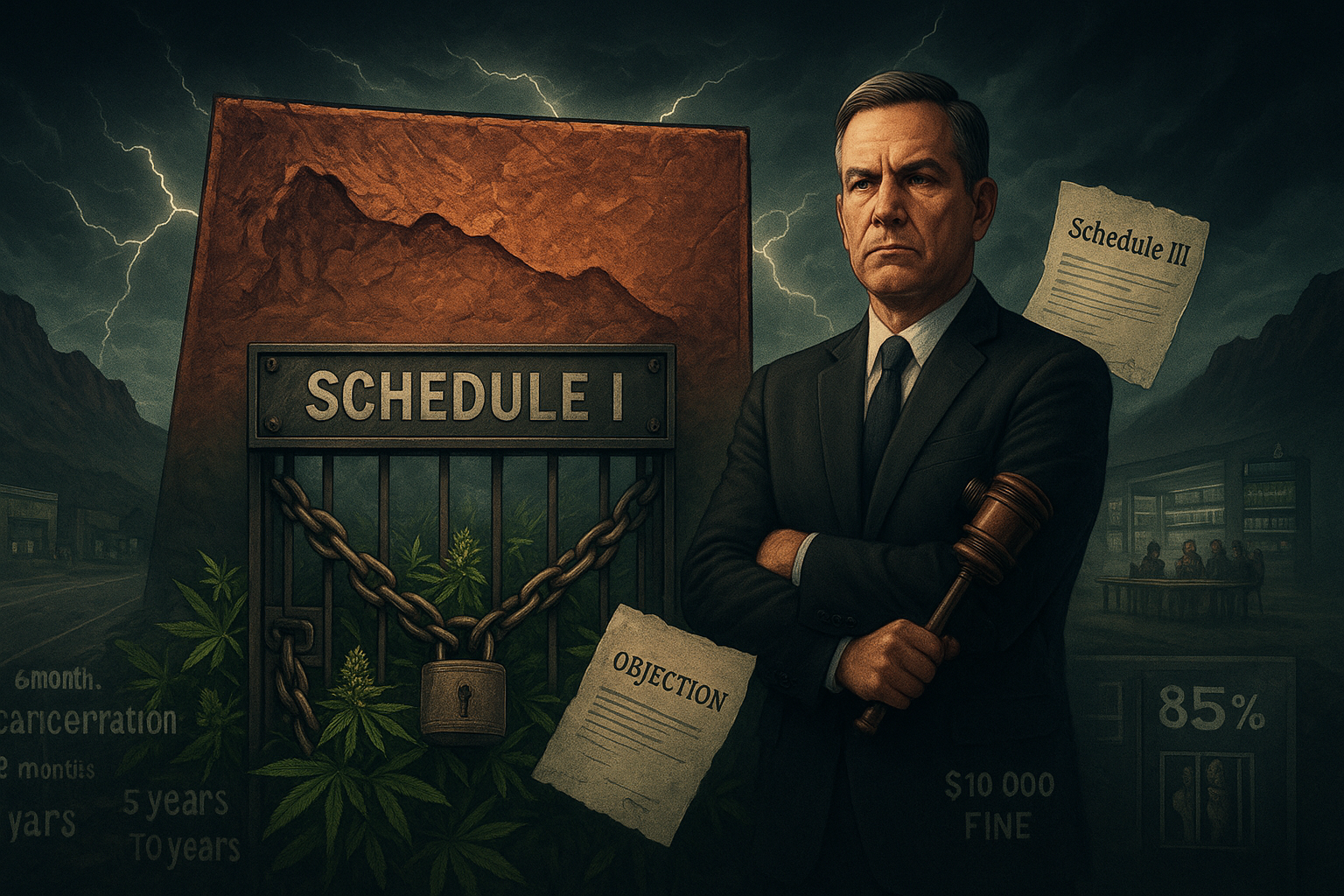
Wyoming Attorney General Keith Kautz officially confirmed on July 7 that the state will not align its controlled substances scheduling with a federal reclassification that moved state-licensed medical cannabis and FDA-approved cannabis products to Schedule III under the U.S. Controlled Substances Act. The decision, made in Kautz's dual capacity as the state's commissioner of drugs and substance control, effectively keeps Wyoming's cannabis policies among the most restrictive in the country - and puts licensed cannabis businesses, patients, and operators in neighboring states on notice that Wyoming's legal wall is staying up, at least for now.
The broader national picture is shifting fast. States with functioning regulated markets - from Colorado's mature adult-use economy to Michigan's competitive multi-operator retail environment - are tracking federal scheduling developments closely because rescheduling carries meaningful implications for tax treatment, banking access, and interstate commerce policy. Operators in those markets rely on infrastructure designed specifically for licensed cannabis retail; a cannabis retail platform for Michigan, for instance, is built around compliance with a state's licensing framework, and any change to federal scheduling status can ripple through everything from point-of-sale system configurations to seed-to-sale tracking requirements. Wyoming's decision to hold its current position is a reminder that federal rescheduling does not automatically resolve the patchwork of state-level restrictions that operators and vendors must account for.
Kautz's legal authority to block the automatic scheduling alignment comes from a provision in Wyoming's own Controlled Substances Act, which requires the state commissioner to mirror federal scheduling changes within 30 days - unless the commissioner formally objects. He did object, on May 27, and was then required by state law to convene a public hearing and consider input from interested parties. What followed was a remarkably thin record of public engagement: nine individuals total, split evenly between those favoring Schedule I retention and those supporting alignment with the federal Schedule III designation, plus one in-person testimony supporting Schedule I. That's nine people deciding - or rather, informing the decision on - a policy that touches the lives of an estimated 85% of Wyoming residents who, according to a December 2020 poll from the Wyoming Survey and Analysis Center at the University of Wyoming, support legalizing medical cannabis.
The Commissioner's Two-Part Rationale
Kautz didn't rely on a single objection. He raised two distinct grounds for blocking rescheduling, and both are worth examining for what they signal about the path forward. First, Wyoming's Legislature has not authorized a medical cannabis program, nor has it recognized the licensing frameworks of other states. Moving cannabis to Schedule III in alignment with the federal rule - which specifically rescheduled "state-licensed medical cannabis" - would implicitly recognize a category of licensed activity that Wyoming has never sanctioned. To Kautz, that amounts to administrative rulemaking overstepping legislative prerogative. Fair enough, as a matter of statutory interpretation; but it also means that until the Wyoming Legislature acts, the commissioner has no mechanism to soften the state's scheduling posture, regardless of what federal law does.
Second, Kautz argued that Wyoming already handles FDA-approved cannabinoid products correctly. He pointed to existing Schedule III and Schedule II listings for synthetic cannabinoid drugs - Dronabinol (Marinol and Syndros) at Schedule III, Cesamet (nabilone) at Schedule II - and noted that Epidiolex, the plant-derived CBD prescription drug, was removed from the federal CSA entirely by the DEA in 2020. Wyoming, he said, mirrors those classifications already. His office's position is that if the FDA approves an additional cannabis-derived product, it will be scheduled accordingly at that time. In practice, though, that framework does nothing for the vast majority of cannabis products currently sold in licensed dispensaries across the country - none of which have FDA approval and none of which Wyoming intends to accommodate.
What Wyoming's Penalties Actually Look Like
It is worth being precise about what Schedule I status means on the ground in Wyoming, because the stakes are not abstract. Being under the influence of cannabis in Wyoming carries the possibility of six months of incarceration. Possessing 3 ounces or less can result in up to 12 months behind bars. Possession of more than 3 ounces can mean up to five years in prison. Selling or distributing any amount is a felony - 10 years of potential incarceration and a $10,000 fine. These are not regulatory misdemeanors. They are criminal penalties that remain fully intact following Kautz's July 7 announcement.
Wyoming is also one of eight states in the country without any licensed and regulated medical cannabis program - not even a highly restrictive program of the kind seen in Texas or Iowa. That absence is significant for the broader industry. Multistate operators, brands, and wholesale suppliers looking at regional market expansion have no licensed entry point into Wyoming. There is no dispensary infrastructure to supply, no compliance framework to integrate with, no seed-to-sale system to connect to. The state's regulatory wall does not just affect patients; it affects every vendor, processor, and logistics provider whose footprint stops at Wyoming's borders.
The Legislative Path Is the Only Path Left
Kautz's announcement was explicit on one point: the decision to reschedule - or not - is "best left with the Wyoming Legislature and should not be done through the administrative rulemaking process." That framing shifts all future momentum squarely onto the Legislature, and the legislative record in Wyoming on cannabis is not encouraging. Activists' most recent effort to put a legalization question before Wyoming voters on the 2024 ballot was unsuccessful.
What's striking here is the gap between public sentiment and policy outcome. Eighty-five percent support for medical cannabis legalization - measured years before the federal government moved to reschedule - has not translated into a ballot measure, a legislative bill, or even a meaningful public hearing. Nine people showed up to participate in a process that will define Wyoming's cannabis enforcement posture for the foreseeable future. That disconnect is its own kind of policy story, separate from the scheduling mechanics.
For the cannabis industry watching from the outside, Wyoming remains a closed door. Federal rescheduling moved the lock. Wyoming's commissioner just changed it back.